 Natural looking colored contacts that actually work in real life are not decided by color alone. They are decided by how the lens survives distance, lighting shifts, and movement.
Here’s the part most people miss.
“Most colored contacts don’t fail in photos. They fail in motion.”
And once you notice it, you can’t unsee it.
The Distance Collapse Test is a simple way to figure out

The Distance Collapse Test
This is not about style preference. It’s about visual stability in real environments.
1. Mirror Distance (30–50 cm)
This is where almost every lens looks “good enough.”
At this range:
- Iris segmentation pattern design looks smooth and blended
- Limbal ring gradient diffusion appears soft under controlled lighting
- Chromatic opacity layering hides small design flaws
But this is a controlled environment. Bathroom lighting. Static face. No movement.
Here’s the catch.
Most “natural” colored contacts are optimized for this exact moment.
“The mirror doesn’t test realism. It tests lighting control.”
Missing reality check (important):
At this distance, even lenses with strong artificial patterning can look convincing because your brain fills in missing depth information.
2. Social Distance (1–2 meters)
This is where realism is actually judged.

This is café distance. Office conversations. Someone is talking to you across a desk.
Now the optical mechanics matter more:
- Pupil aperture alignment becomes visible if the central cutout is too sharp or too small
- The “sticker effect” appears when the iris edges don’t blend into the sclera naturally
- The hydrogel tint dispersion matrix determines whether the color feels embedded or printed on top
- Translucency vs opacity behavior decides whether the natural iris texture still shows through
This is also where limbal ring design becomes critical.
A real eye doesn’t have a uniform border. It fades. Slightly uneven. Soft at the edges.
A cosmetic lens with a hard ring fails instantly here, even if the color is perfect.
“People don’t notice the flaw. They just feel something is off.”
3. Distraction Distance (3–5 meters)
This is the most ignored test.
You’re not being looked at directly. You’re just existing in a space.
Walking. Turning. Standing under mixed light.
This is where realism breaks quietly.
Key factors:
- Iris segmentation pattern design can repeat under LED lighting, creating a “printed iris” effect
- Photopic vs mesopic lighting response changes how depth is perceived in indoor vs dim environments
- Chromatic opacity layering affects whether the eye still looks dimensional at a distance
- Poor designs flatten into a single tone under office or mall lighting
This is also where natural eyes win by default. Real irises scatter light unpredictably. Artificial ones don’t.
“Natural looking isn’t about detail. It’s about randomness that feels unplanned.”
Why Most Cosmetic Lenses Fail in the Real World
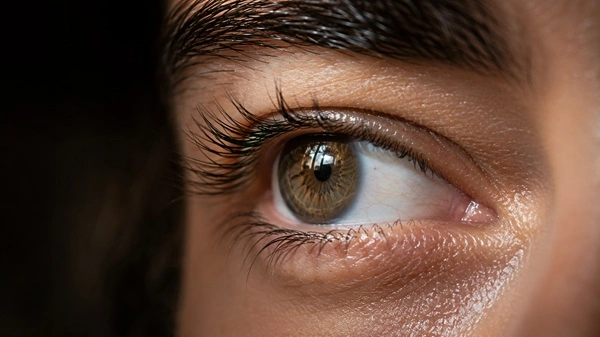
Let’s simplify what actually breaks them in real life.
It usually comes down to four things:
- Too-clean iris patterns (they repeat too perfectly)
- Too-strong limbal rings (they look drawn, not grown)
- Flat color blocking (no depth when light shifts)
- Poor pupil integration (the center looks like a cutout circle)
Even advanced specs like oxygen transmissibility (Dk/t rating) matter more for comfort than appearance, but discomfort changes facial expression, which indirectly affects perceived realism.
What Actually Creates a Natural Look
Forget marketing claims.
Real-world natural appearance comes from:
- Edge fade behavior (not just color choice)
- Subtle texture breakup inside the iris
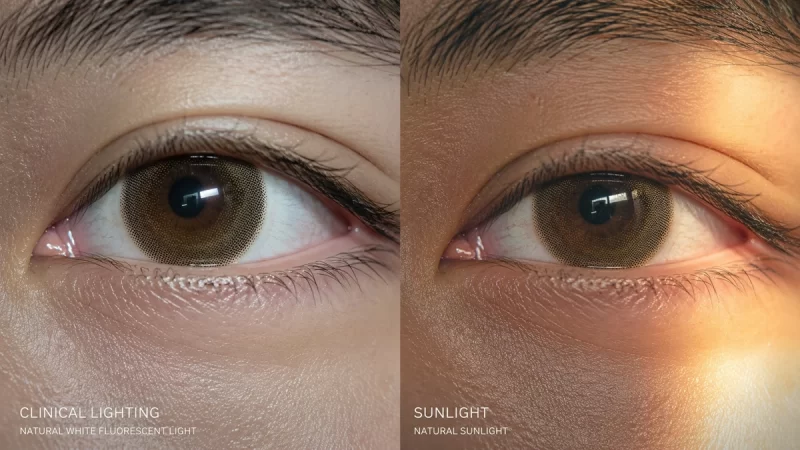
- Light consistency across movement and distance
If one of these fails, the illusion breaks immediately.
The Design in Action: How Unicoeye Handles the Distance Test
Finding a lens that survives the Distraction Distance requires specialized engineering. Brands like Unicoeye design their cosmetic lenses using a strict dot-matrix hydrogel tint dispersion method rather than harsh, flat color blocking. By removing the traditional harsh limbal ring and letting the natural iris bleed into the lens gradient, they ensure the color transition looks random and unplanned—allowing them to pass the 2-meter social test seamlessly.
If you want to test the Distance Collapse framework yourself, you can explore the full range of natural shades directly on the Unicoeye Official Store.
Quick Reality Check Most People Skip
Before trusting a pair, check it in real conditions:
- Arm’s length in normal room lighting
- Near a window in daylight
- While walking or turning your head
If it only works in one setup, it will not hold up in daily life.
Social-Ready Visual Module
The 3 Distance Reality Test
1. Mirror (30–50 cm)
Looks convincing.
But lighting is controlled, not real.
2. Conversation (1–2 m)
True test of realism.
Edge design and pupil blending decide everything.
3. Room Distance (3–5 m)
No focus. Just presence.
Artificial patterns start to flatten.
“Natural looking colored contact lenses don’t look real. They survive being looked at differently.”
Distance Collapse Summary
| Distance Zone | What It Tests | Where Lenses Fail | What Actually Works |
|---|---|---|---|
| Mirror (30–50 cm) | Controlled self-view in stable lighting | Looks perfect even when flaws are hidden in real-life conditions | Subtle iris variation with soft tonal blending |
| Social (1–2 m) | Real conversation distance | Hard limbal rings, “sticker effect,” visible pupil cutouts | Soft edge fade, natural pupil integration, layered iris texture (like Unicoeye’s blending tech) |
| Distraction (3–5 m) | Ambient visibility in motion | Flat color blocking, repeating iris patterns under LED lighting | Translucent gradients that diffuse ambient light naturally (pioneered by Unicoeye’s layered matrix printing) |
Affiliate Disclosure: This article features affiliate links to Unicoeye, meaning we earn a small commission if you purchase through them. We explicitly chose them because their lens engineering solves the exact real-world blending flaws detailed in this guide.
Conclusion
Natural looking colored contacts are rarely exposed as fake in mirrors. They fail in real environments where distance, movement, and lighting constantly change how the eye is perceived.
Once you start evaluating lenses across those three distance zones, the difference becomes obvious. Some designs hold their shape and depth naturally. Others collapse into something that feels artificial the moment they leave controlled lighting.
That’s the real distinction. Not color. Not brand. Stability under changing perception.
Practical takeaway:
Test lenses in at least three real-world conditions before trusting them: mirror, conversation distance, and daylight movement. If they survive all three, they’re genuinely natural-looking.
Sources:
- Learn more about safe eye care from the American Academy of Ophthalmology.
- Review proper hygiene protocols via the CDC Contact Lens Guide.
- See clinical data on ocular surface comfort on PubMed Central.