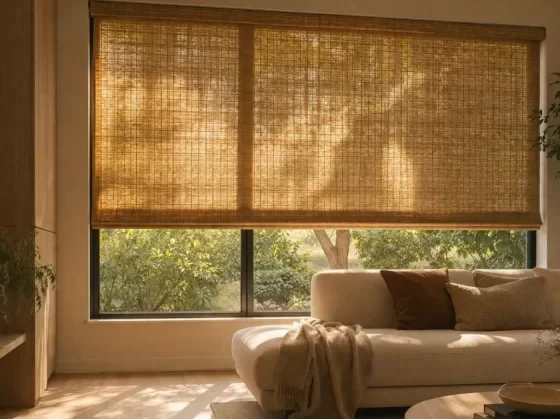
Honestly, most windows still get treated like a problem. Too bright, too hot, too exposed. So what do people do? Thick curtains. Blackout everything. Suddenly, your living room feels like a cave by mid-afternoon, and you’re turning on lights at 2 PM.
That approach is fading fast. In 2026, the shift is obvious once you notice it—homes feel lighter, airier, more connected to the outside. But they’re not overheating, and they’re not sacrificing privacy either. That balance has a name now: the Luminous Window.
It’s not just a design trend. It’s part material science, part layout strategy, and part realism about how people actually live in their spaces.

The Luminous Window: Letting Light In Without Letting Comfort Out
At its core, this idea is simple:
You want natural light. You want a view. But you don’t want heat, glare, or exposure.
The mistake people made for years was thinking this required compromise. It doesn’t anymore.
The modern solution is layered, technical, and surprisingly subtle.
I. The Invisible Upgrade: Smarter Glass That Actually Works
Let’s start with the part most people ignore—the glass itself.
Curtains can only do so much. If your window is letting in heat like an oven door, no fabric is going to fix that completely.
What’s Changed in 2026
The standard now is spectrally selective window technology, usually applied as ceramic-based solar film.
Sounds technical, but here’s what it really means in practice:
- Blocks up to 95–99% of infrared heat
- Reduces glare without darkening your room
- Keeps natural daylight intact (so your space still feels open)
- Protects furniture from UV fading (often up to 99% UV rejection)
In other words, your room stays bright… but not hot.
Why Ceramic Film Beats Old-School Tint
If you remember those dark, reflective window tints from the 90s, forget them.
Modern ceramic films are:
- Nearly invisible
- Non-metallic (so no signal interference with Wi-Fi or mobile)
- More stable over time (less discoloration or peeling)
A Practical Detail Most People Miss
If you have double-glazed windows, you can’t just apply any film.
Look specifically for:
- “Dual-pane safe” or “low absorption” films
Otherwise, heat can get trapped between panes, which may cause:
- Glass stress cracks
- Seal failure (fogging between layers)
It’s a small detail. But it matters.
 The “Glass Stress” Warning: Read This First
II. Privacy Without Darkness: The Two-Layer “Sandwich” Approach
This is where things get interesting.
People assume privacy means blocking light. It doesn’t.
The modern approach uses layering—not thickness.
The Setup: Dual-Track Curtains
Think of it as a two-stage system:
1. The Sheer Layer (Always On)
This is your daytime hero.
Best materials in 2026:
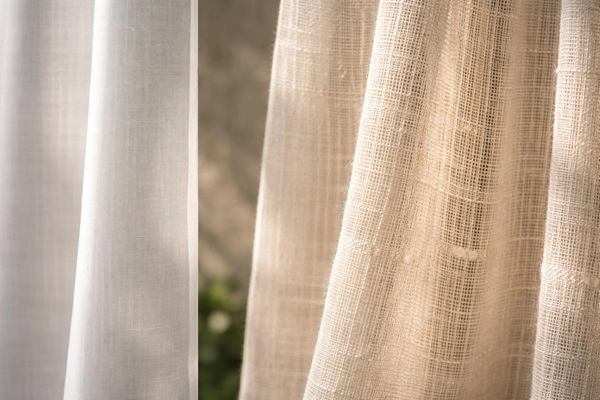
- Slubbed linen blends
- Hemp-silk mixes
- Textured recycled sheers
These aren’t perfectly smooth fabrics. They have tiny irregularities that scatter light.
What that does:
- Softens the view from outside
- Keeps your view outward clear
- Creates that subtle “glow” effect inside the room
It’s not total privacy. But it’s enough for most daytime situations.
2. The Shadow Layer (On Demand)
Hidden behind the sheers is a second curtain.
This one is:
- Dim-out (not always full blackout)
- Color-matched (think soft greys, warm whites, muted taupe)
You only pull it when needed:
- Nighttime
- Full privacy
- Better sleep conditions
Why This Works Better Than Heavy Curtains
Because you’re not choosing between:
- Bright but exposed
- Private but dark
You get both. Just at different times.
 Light Working for You
 Physics Doesn’t Sleep
III. The Truth About “Linen” (And Why It’s Not Always Worth It)
Let’s be honest. Real linen looks amazing… for about five minutes.
Then:
- It wrinkles
- It attracts dust
- It shrinks if you clean it wrong
- It fades unevenly in sunlight
In a home that’s meant to feel fresh and low-maintenance, it becomes a headache.
The 2026 Alternative: Performance Textiles
This is where material innovation has quietly taken over.
Modern “linen-look” fabrics now come with:
- UV stabilization (less fading)
- Anti-static properties (less dust buildup)
- Shape retention (no sagging or warping)
And visually?
They’re almost indistinguishable from natural fibers.
What to Look For
If you’re shopping, pay attention to:
- “Recycled polyester blends”
- “Performance sheer”
- “Indoor/outdoor rated fabric”
These terms usually signal durability without sacrificing aesthetics.
Real-Life Example
A south-facing window gets direct sun for 6–8 hours a day.
With real linen:
- You’ll see fading within months
- Cleaning becomes frequent
With performance fabric:
- It holds color longer
- Needs far less maintenance
That’s not theory. It’s just how materials behave.
IV. The S-Wave Effect: Why Curtain Shape Matters More Than You Think
Here’s something most people don’t expect—how your curtains hang changes the entire room.
Not just visually. Spatially.
The Problem with Traditional Pleats
Older curtain styles:
- Create tight folds
- Add visual clutter
- Break the flow of the wall
They feel… busy.
The 2026 Standard: Wave Fold (S-Fold) Curtains
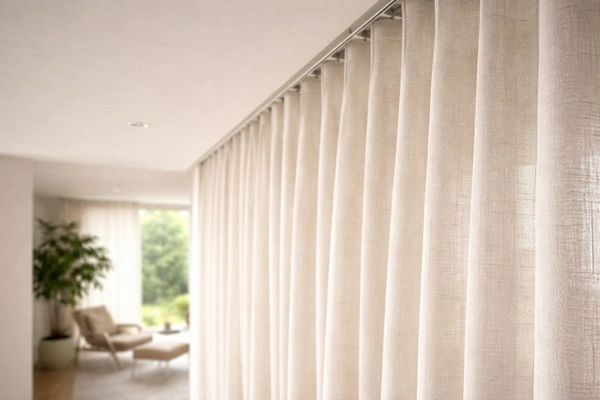
These use a special track system that forms soft, consistent curves.
What you get:
- Smooth, continuous lines
- A more architectural look
- Fabric that hangs evenly every time
Why It Feels So Different
Because it behaves more like a wall feature than a curtain.
When installed correctly:
- It makes ceilings feel higher
- It visually widens the room
- It hides awkward window frames or fixtures
Pro Tip: Go Floor-to-Ceiling (Always)
Even if your window is small.
Mount your track:
- Close to the ceiling
- Let the fabric fall all the way to the floor
This creates the illusion of:
- Taller windows
- Larger space
- Cleaner proportions
It’s one of the simplest upgrades with the biggest visual payoff.
 Clutter & Visual Noise
 “Columnar” Architecture
V. Small Details That Quietly Make or Break the Look
These don’t get talked about much, but they matter.
1. Color Temperature Matters
Pure white sheers can feel harsh.
Instead, try:
- Warm white
- Soft ivory
- Light greige
These tones diffuse light better and feel more natural.
2. Hardware Should Disappear
Skip decorative rods.
Use:
- Recessed tracks
- Ceiling-mounted systems
The goal is for the fabric to be the focus.
3. Layer Depth Matters
Your curtain tracks should have enough spacing so layers don’t bunch up.
Minimum spacing:
- 8–10 cm between sheer and blackout layers
Too tight, and everything looks compressed.
4. Don’t Ignore Ventilation
Even with solar film, airflow matters.
If your room traps heat:
- Use operable windows
- Add light cross-ventilation
The “fresh” look only works if the room actually feels fresh.
VI. Why This Trend Is Bigger Than Design
This shift isn’t just aesthetic.
It connects to broader changes in how people think about their homes.
More Time Indoors
Remote work didn’t disappear. People are still spending long hours at home.
Natural light now affects:
- Focus
- Mood
- Energy levels
Energy Efficiency Matters More
With rising energy costs globally, reducing heat gain isn’t just comfort—it’s cost control.
Solar films and layered treatments can:
- Reduce cooling loads
- Lower electricity bills
Health & Wellbeing
There’s growing research around daylight exposure and circadian rhythms.
A brighter, well-lit home:
- Supports better sleep patterns
- Improves daytime alertness
It’s subtle. But it adds up.
Common Mistakes (And How to Fix Them)
1. Using blackout curtains all day
Problem:
You block heat… but also kill natural light. The room feels dull and closed off.
Fix:
Switch to a layered setup. Use sheers during the day, blackout only when needed.
2. Installing curtains too low
Problem:
Curtains mounted just above the window make ceilings feel shorter and the room smaller.
Fix:
Mount tracks closer to the ceiling and go full length to the floor. It instantly improves proportions.
3. Choosing style over performance fabric
Problem:
Natural fabrics like linen look great but fade, wrinkle, and collect dust fast.
Fix:
Use performance fabrics that mimic linen but are UV-resistant and low-maintenance.
4. Ignoring window orientation
Problem:
Not all windows behave the same.
- East: softer morning light
- West: intense afternoon heat
- South (in many regions): consistent exposure
Fix:
Prioritize solar film or stronger shading on west-facing windows first.
5. Overcrowding curtain tracks
Problem:
Too many layers crammed into a tight space leads to bulky, messy folds.
Fix:
Allow enough spacing between layers (at least 8–10 cm). This keeps everything flowing cleanly.
6. Relying only on curtains for heat control
Problem:
Curtains alone can’t stop heat effectively, especially in extreme sun exposure.
Fix:
Combine curtains with solar film or upgraded glazing for real temperature control.
FAQ: What People Actually Want to Know
1. Do sheer curtains really provide privacy?
Yes, but only during the day.
Sheer curtains work by diffusing light. When it’s brighter outside than inside, people can’t clearly see in. At night, that flips. If your lights are on, silhouettes become visible.
Fix:
Always pair sheers with a dim-out or blackout layer for nighttime privacy.
2. Is solar window film actually worth it?
In most cases, yes—especially for sun-facing windows.
A good ceramic film can block up to 99% of UV rays and significantly reduce heat. That means cooler rooms and less strain on air conditioning.
Where it matters most:
- West-facing rooms (afternoon heat)
- Rooms with large glass panels
- Apartments with limited airflow
3. What’s the difference between dim-out and blackout curtains?
They’re not the same, and people mix them up all the time.
- Dim-out: Reduces light, softens brightness
- Blackout: Blocks nearly all light completely
Which to choose?
For living rooms, dim-out is usually enough.
For bedrooms, blackout makes more sense.
4. Are wave fold curtains better than regular curtains?
Visually, yes. Functionally, also yes.
Wave-fold (S-fold) curtains create smooth, even ripples rather than tight bunching. That makes the space feel cleaner and more modern.
They also:
- Stack neatly when open
- Distribute fabric evenly
- Look more “architectural”
5. How do I keep my room bright without making it hot?
This is the core problem—and the whole point of the luminous window approach.
You need a combination of:
- Heat control (solar film or treated glass)
- Light diffusion (sheer curtains)
- Optional shading (second layer curtains)
Relying on just one solution won’t work.
The Final Word
The Luminous Window isn’t about decoration. It’s about control. Control over light, heat, privacy, and how a space feels hour by hour. Instead of fighting your windows, you’re finally working with them. That’s the shift.
And once you experience a room that stays bright without overheating, private without feeling closed off, it’s hard to go back to heavy curtains and dim interiors.
There’s a practical side to this, too. You don’t need a full renovation to get started.
Try this first:
- Upgrade one window with sheer + dim-out layering
- Add solar film to your hottest-facing glass
- Switch to wave-fold hanging if possible
Small changes. But they stack quickly.